

REVIEW: ‘The Effect’ spars with big ideas on psychology
The staging of The Effect is minimal, but a lot more clever than it might initially look. Director Sarah Facuri and set designer D Cortezano place the action inside a square divided into four quadrants, with two folding chairs positioned diagonally across opposite corners. It gives the impression of a boxing ring, which makes sense: for most of the play, its four characters are essentially sparring with one another.
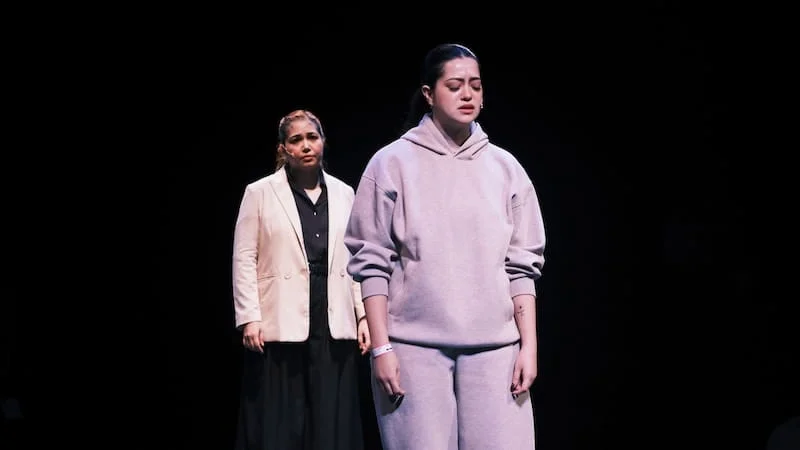
Even the costumes subtly extend the metaphor. The two subjects of an antidepressant drug trial, Connie Hall (Sue Ramirez) and Tristan Frey (Brian Sy), wear matching gray jumpsuits. Dr. Lorna James (Cathy Azanza-Dy) wears black smart casual under a white coat, while Dr. Toby Sealy (Dean Daniel Rosen) wears a white button-down under a black sports coat. The doctors appear almost as visual inverses of one another, while Connie and Tristan are dressed alike: in the same boat, and ultimately collateral damage of whatever the doctors are doing.
It is a vast platform set in the round, and the four actors are rarely, if at all, helped along by other set pieces or props. The show doesn’t really need much more. Its sparseness puts Lucy Prebble’s writing and the arguments she presents front and center, while placing an equal burden on the actors to carry their characters’ stories across.
Sparring partners
Of the four, Lorna is the most interesting. She’s a psychiatrist who has herself experienced depression, yet is deeply skeptical of antidepressants. She also gets some of the play’s most compelling and memorable lines, which is interesting because she doesn’t necessarily possess its soundest takes. Much of the character’s pull comes down to Azanza-Dy’s performance. She gives Lorna the air of a doctor who is only barely coping, a depressive weight hanging over her even when she is supposed to be the person clinically observing everyone else.
Facuri’s staging and Azanza-Dy’s performance ultimately make Lorna feel like the production’s protagonist.Tristan and Connie may be the ones taking the drug, but the show becomes less about the effect of the trial on them than the clinical trial’s effect on her.
Rosen makes an effective counterpoint to Azanza-Dy. Being Filipino-British, he puts on the accent, and the quick dryness of Prebble’s writing comes out, especially once Toby and Lorna really get to sparring. At the same time, Rosen gives Toby a curiously lackadaisical air. He can come across like a ‘bloke with a job’ rather than a high-powered, cutthroat medical technocrat pushing a new pill. He’s so everyman that it’s almost difficult to reconcile this Toby with the conference Casanova Lorna once fell for.
Lab lovebirds
Sy and Ramirez, meanwhile, are well suited as the two subjects and eventual lovers. Sy is the kind of actor whose choices tend to disappear comfortably into his characters, and Tristan is no exception. Ramirez, who made her stage debut as Audrey in Little Shop of Horrors two years ago, again shows a strong aptitude for live theater in material very different from a musical: pared down, talkative, and thorny.

Sue Ramirez (Connie Hall), Brian Sy (Tristan Frey); Photo Credit: Ynah Garcia
And perhaps, there isn’t supposed to be anything particularly exceptional about either Connie or Tristan. Yet what Sy and Ramirez make palpable is the physical escalation of their romance. As the trial’s dosage increases, their intimacy seems to rise with it. The pharmacology becomes something we can watch happening between two bodies.
Their characters may have fundamental differences that add to the question of whether they might have fallen for each other under different circumstances. However, it isn’t highlighted as strongly as their shared status. They are two different kinds of people, with different ways of understanding what’s happening between them, but Facuri’s production more readily emphasizes that they’re both experimental subjects.
Sci-fi air
There is something vaguely sci-fi, even Black Mirror-ish, about the production: four people sequestered away in some remote institute, clinically testing an antidepressant whose effects are still unknown. Part of why it lands that way may have to do with the distance of its premise and its staging here.
Prebble’s play emerges from a culture in which antidepressants and the arguments surrounding psychopharmacology already occupy a relatively familiar place in the public conversation. In the Philippines, that conversation can still feel several steps ahead. It feels as though we’ve only recently begun destigmatizing talk therapy—even among supposedly progressive circles. Our concerns are closer to getting access to affordable quality mental health than whether or not our society may be playing fast and loose with psych pills.
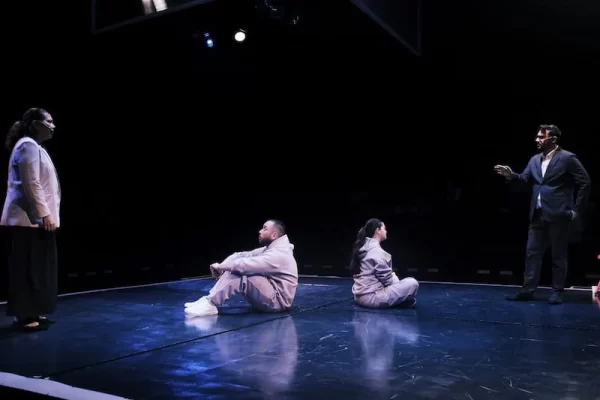
L-R: Dean Daniel Rosen, Brian Sy, Sue Ramirez, Cathy Azanza-Dy; Photo Credit: Ynah Garcia
The effect (pun intended) is that the play’s larger themes come across primarily as a debate. Facuri’s staging reinforces this: put four characters inside a sparring ring and their differing points of view inevitably start to look like positions waiting to be tested against one another. The production presents its arguments lucidly. Their urgency here and now is less certain.
The drug debate
And this may be why the conclusion of Connie and Tristan’s story doesn’t land as powerfully as it seemingly ought to. Connie takes care of Tristan even after the drug’s effects have worn off on her, and we watch her experience the gamut of emotions one feels for a true partner rather than the intensity one may have towards a new lover or fling. Her care for him would seem to answer the experiment’s central anxiety: whatever caused their initial attraction, what remains between them cannot simply be dismissed as drug-induced.
It ought to be one of The Effect‘s most powerful implications. But because the production so successfully turns its stage into an arena for competing ideas without making the larger “why” of those ideas feel equally urgent, the aftermath of the trial feels less like the culmination of its argument than the slow wrapping up of Connie and Tristan’s love story. The bell of this boxing match has rung but what has been settled remains unclear.
This reviewer watched the 3PM, September 20 show.
Tickets: ₱2,000, ₱1,800
Show Dates: September 19–27, 2026
Venue: Doreen Blackbox Theater, Areté, Ateneo de Manila University
Running Time: approx. 2 hours (no intermission)
Producer: CAST PH, Areté
Creatives: Sarah Facuri (director), Teia Contreras (assistant director), D Cortezano (set design), Jethro Nibaten (lighting design), Carlos Hombrebueno (sound design)
Cast: Sue Ramirez (Connie Hall), Brian Sy (Tristan Frey), Dean Daniel Rosen (Dr. Toby Sealy), Cathy Azanza-Dy (Dr. Lorna James), Chaye Mogg (understudy for Connie Hall)

Comments