

Who Wrote the Music? On Authorship, Attribution, and the Future of Philippine Musicals
As new musicals continue to emerge, publicly identifying their composers and lyricists means more than giving credit. It is about preserving authorship, artistic history, and the humanity behind the work.
In musical theater, the composer and lyricist are among the principal creators of the work. Their names are inseparable from the identity of the musical itself.
What is Wicked without Stephen Schwartz? Hamilton without Lin-Manuel Miranda? Les Misérables without Claude-Michel Schönberg and Alain Boublil? The Sound of Music without Richard Rodgers and Oscar Hammerstein II? Sweeney Todd without Stephen Sondheim? Jesus Christ Superstar without Andrew Lloyd Webber and Tim Rice? Himala: Isang Musikal without Vincent A. DeJesus and Ricky Lee? Ang Larawan without Ryan Cayabyab and Rolando Tinio? Bar Boys: A New Musical without Myke Salomon and Pat Valera? Gregoria Lakambini: A Pinay Pop Musical without Nica Del Rosario, Matthew Chang, Nicanor Tiongson, and Eljay Castro Deldoc? Pingkian: Isang Musikal without Ejay Yatco and Juan Ekis?
This raises an important question: what is a musical without a publicly credited composer or lyricist?
Who Wrote the Music?
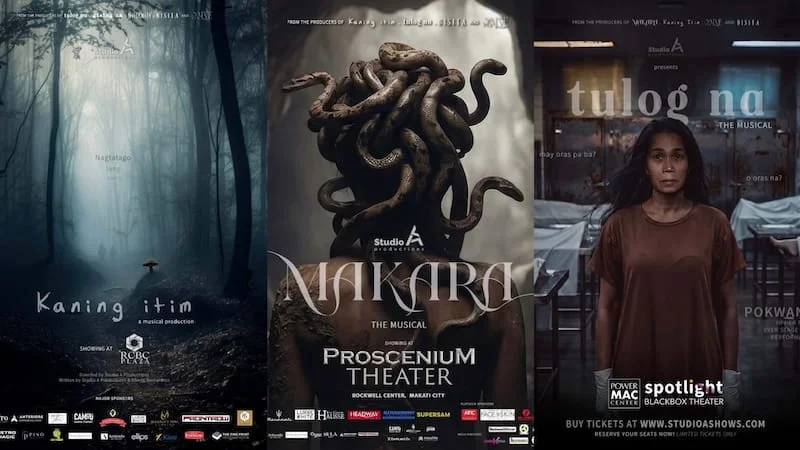
Studio A Productions is set to stage Tulog Na: The Musical this August at the Power Mac Center Spotlight. It is a musical adaptation of the company’s play, Tulog Na, which, according to Studio A Productions, completed 136 sold-out performances over two years and has been seen by more than 20,000 audience members. The production will also mark screen actor Pokwang’s live theater debut.
Publicly, Studio A Productions identifies Danna Bernardino as the musical’s writer and Jef Albea as its director.
As for the cast, Pokwang is joined by Cherry Morena as Tamara, Cary Faith Rodolfo as Biyang, Jeremy Manite as Jojo, Primitivo Moscare as Rochelle, Nicollo Gutierrez as Rex, Farrah Era as Josie, Zenaida Sevilla Loyola as Alya, Jimson Buenagua as Mal, Rachel May Lagad as Grace, Eunice Somintac as Angela, Kaiser Cortina as Gelo, Jude Gamaliel Tan as Victor, Geanne Del Monte as Karen, Jena Vanderson as Lily, and Len Vanderson Vince.
Tulog Na: The Musical is the company’s tenth original production since its founding in 2023. It is also its third musical, following Kaning Itim and Makara.
Like Tulog Na: The Musical, the company’s two previous musicals also did not publicly identify a composer or lyricist.
When I asked theater artist Myke Salomon what it means to him when an original musical does not publicly identify its composer and lyricist, he said, “If a musical can’t credit a composer and lyricist, then stop calling it a musical.” Salomon has worked as a producer, actor, composer, music arranger, and musical director.
Composer, lyricist, and musical director Matthew Chang shared a similar view.
“To me, it raises questions about authorship and creative transparency. Music is at the heart of any original musical, and the composer, lyricist, and arranger each have distinct roles. The composer and lyricist create the songs, while the arranger builds on that work. That’s why I believe all three should be publicly acknowledged for the roles they played. Any original musical should prioritize recognizing the artists responsible for creating its music.”
The show’s social media materials also note that the musical features Sugarfree’s song “Tulog Na,” with credits listing Ebe Dancel as composer, Erik Santos as performer, Jonathan Manalo and Erik Santos as producers, and Jem Florendo as music arranger. We reached out to Dancel to ask whether his involvement in the production extended beyond the inclusion of his song, and to Manalo to clarify the scope of his credit, but have yet to receive a response.
Who Is JR Dee?
When asked who composed the music for Makara, one of the show’s producers, Russell Tee, replied simply, “The music was composed by Studio A.”
When I asked who wrote the music and lyrics for Tulog Na: The Musical, the company’s marketing representative initially responded via email:
“The music and lyrics for the musical were composed by Studio A Productions’ in-house creative team, working collaboratively to develop the show’s original score.”
When I followed up by asking for the names of the composers and lyricists and requested the full creative team roster, the company identified JR Dee under “Music and Lyrics” and also provided additional creative team members: Janet Subito and Leri Lingatong (costume mistresses), Jef Albea (costume and set designer), Mark Albea (lighting designer), and EJ Baliton (sound designer).
I then requested an artistic profile for JR Dee and asked whether an interview could be arranged. I have not received a response.
We searched publicly available sources and reached out to members of the theater community but could not locate any publicly documented artistic background, portfolio, or previous credits under that name.
A Shifting Explanation
What was first described as the work of an in-house creative team was later attributed to a single individual. Why that attribution changed remains unclear.
Danna Bernardino, a sculptor and visual artist outside her work with Studio A Productions, is the company’s resident playwright. According to the Philippine Daily Inquirer feature “The Fearlessness of Studio A Productions,” Bernardino had never written for the stage before Gising Na, which opened in 2023 as the company’s very first production, although she had been writing since she was young. The article adds that the group collaborated on that particular story before Bernardino fleshed it out. “There’s always a bit, if not a lot, of me in each line, in each story,” she said.
In an interview with Bilyonaryo about Kaning Itim, Bernardino was asked about the challenges of creating original music for the company’s first musical.
“The entire thing is a challenge actually, since iyun nga, first musical ‘to. Wala naman kaming alam pa. We know what we wanted to show pero hindi namin alam how, so sobrang team effort talaga siya. We exhausted all our creative juices how to pull it off.”
Notably, Bernardino describes the creation of Kaning Itim’s score as a “team effort,” echoing Studio A’s initial explanation to us that the music and lyrics for Tulog Na: The Musical were created collaboratively by its in-house creative team.
A Record of Authorship
At a time when technology makes it easier than ever to generate, remix, and obscure creative work, identifying the people behind that work matters more than ever.
We go to the theater not simply to consume stories, but to encounter the people who made them. Every score, every lyric, and every line of dialogue has an author. Identifying those creators allows us to celebrate their work, understand their creative contributions, and preserve the history of our theater.
Whether a musical is written by one person or by a collaborative team, the creators deserve to be publicly identified. Attribution is not a formality; it is a record of authorship. It allows artists to build careers, audiences to understand who made the work, and future collaborators to trace a creator’s body of work.
If we stop asking who wrote the music and lyrics, we lose more than a line in a program. We lose the ability to recognize the human beings behind the work and the creative labor they have given to it. At a time when our creative industries are being reshaped by technology, preserving that humanity is more important than ever.
Every musical should have a human being attached to its music and lyrics, not just privately, but publicly. Audiences deserve to know whose voice they are hearing. Artists deserve to have their work recognized. And theater, perhaps now more than ever, deserves to preserve the humanity of the people who create it.

Comments