

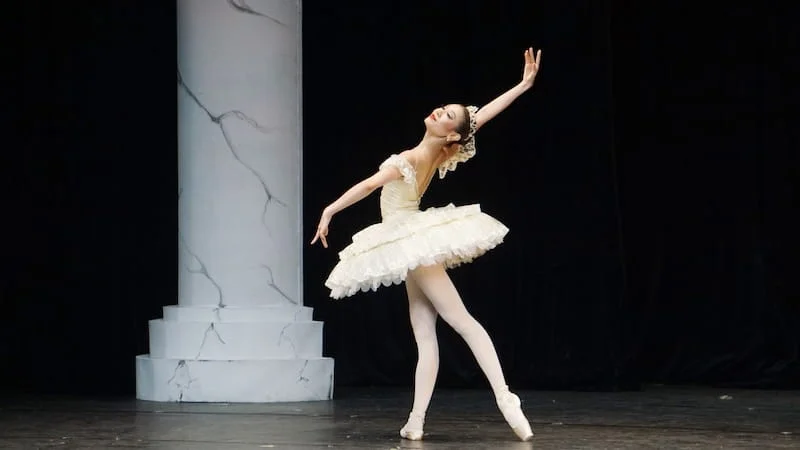
REVIEW: Ballet Manila Pushes ‘Paquita’ Forward
Ballet Manila’s world premiere of Paquita arrives as more than a showcase of technique. Beneath its familiar bravura passages and grand classical form is a portrait of Lisa Macuja Elizalde’s artistic journey, from the ballerina who once commanded the stage to the choreographer shaping a full-length ballet with a theatrical eye.
The company’s 2026 Prima Season celebrates her 40 years in Philippine ballet, tracing an evolution that has taken her beyond performance into the demanding work of creating worlds, characters, and narratives through movement.
Elizalde resists the temptation to let choreography stand alone. She creates backstories of her principal characters and fills in the narrative gaps that often leave classical productions feeling fragmented. Hers is a version that has the formula of a TV soap opera to keep audiences emotionally invested between the dances. She creates most of the choreography, preserving two classic Russian staples, the Grand Pas Classique and the Pas de Trois, while reshaping everything else to suit her narrative aims.
The score receives the same careful shaping from Elizalde. Musical selections are woven together with an editor’s instinct, supporting the dramatic flow rather than simply creating a parade of virtuosic moments. The choices strengthen transitions and give the dancers clearer reasons for each movement. Onstage, the effect is a ballet where even decorative passages serve a larger purpose.
Familiarity does not make Paquita predictable. When the choreography draws from classical traditions, the production relies on theatrical detail and deliberate staging to keep the story alive. Visual storytelling, pacing, gesture, and mime give emotional weight to moments that could otherwise pass as ornament.
BACK STORIES
Elizalde builds the ballet around a melodramatic narrative based on the traditional story. She begins with the prologue at the residence of the Comte d’Hervilly. The count paints a portrait of his brother, his sister-in-law, and their young niece, Paquita. He gives the little girl a locket containing a miniature version of the family portrait and introduces her to her cousin, Lucien. That evening, bandits attack Paquita’s family stagecoach. Her father is killed, and the attackers kidnap the young Paquita, who is later raised by the Romanis, the old name for Gypsies.
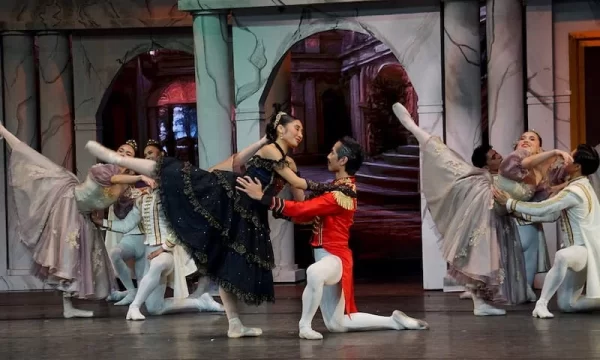
Stephanie Santiago (Doña Seraphina), John Balagot (the Governor); Photo Credit: Teddy Pelaez
Years later, the Comte d’Hervilly and his family arrive in Val de Toros near Zaragoza, a region under French occupation. A monument is being built there in honor of the French who died in the war, setting the stage for the encounter between the French officers and the Spanish governor Don Lopez de Mendoza. The Count, his wife, and Lucien (Mark Sumaylo) meet the Spanish Governor (John Balagot) and his sister Doña Seraphina (Stephanie Santiago). The Count proposes that Lucien marry Doña Seraphina, but the Governor is displeased, as the offer comes amid French occupation of his territory and stirs both resentment and pride.
The entertainment begins when the Gypsies arrive, led by Iñigo (Romeo Peralta). Their entrance brings the Pas de Trois, a showcase that introduces the energy and character of the Romani community. Paquita (Abigail Oliveiro) performs for the French guests under the watchful eye of Iñigo, who has been forcing her to dance for money. Yet an immediate attraction develops between Paquita and Lucien.
Seeing their connection, the Governor finds an opportunity. He enlists Iñigo to assassinate Lucien. The two men set a trap by sending a message that Paquita wants to meet Lucien at her home. Paquita eventually discovers the plot and prevents Iñigo’s attempts to poison and stab the French officer.
In the Count’s ballroom, the Governor is astonished to see Lucien alive and accompanied by Paquita. Lucien reveals how Paquita saved his life and proposes to her. She initially refuses, believing that her social status prevents her from marrying an aristocrat.
The resolution arrives when Paquita notices a familiar painting in the ballroom. The image matches the miniature inside her locket, revealing her connection to the family portrait. She discovers that she was kidnapped as a child and raised by the Gypsies, but was actually born into French aristocracy.
The production culminates in a celebratory wedding featuring Marius Petipa’s Grand Pas Classique, a showcase of the corps de ballet’s geometric formations and solo variations that bring the ballet to its grand finale.
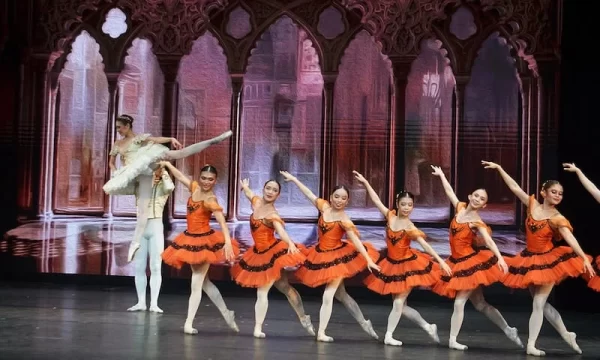
Grand Pas Classique; Photo Credit: Teddy Pelaez
STANDOUTS
The ballet’s standout is Abigail Oliveiro, who inhabits the title role with a vivacity and free-spirited energy that makes the character feel human. This is her most assured performance, combining solid technique with expressive nuance, and she holds the stage through both lyrical and virtuosic passages. She captures the flirtatiousness of the heroine without excess, while her turns and balances reveal steady control. Elizalde does not make the choreography easy for her dancers. Yet, Oliveiro responds with clarity, stretching and extending her limbs, reaching into the final breath of each held pose.
She is partnered by Mark Sumaylo, her real-life husband, who plays Lucien. As always, he commands the stage through presence and authority. He is not a flashy dancer, but he delivers the series of traveling jumps with scissor action, showing height, line, and control in the air, and clean placement on landing after the open split position, even within fast-moving phrases.
Petipa’s Pas de Trois is a divertissement built on clarity and display, often placed in Act 1 as a showcase of classical form before the larger dramatic and technical climaxes. Danced in a trio with linked arms and buoyant, lilting footwork, it moves through variations that highlight individual dancers while maintaining a shared musical pulse. It works as a prelude, establishing athleticism and finesse with youthful energy.
Rafael Perez, hovering in the air through much of his variation, delivered a flash of virtuosic precision. This was most evident in his cabrioles. This is a beaten jump where the legs strike together in midair before opening again, thus creating a sharp, snapping effect. He also executed fast, darting jumps that sliced through space with powerful attack.
Shaira Comeros delivered an alluring performance, taking both space and phrasing with confidence, stretching into her positions and epaulement in ways that gave her technique greater breadth and projection.
Jasmine Pia Dames brought her usual lace-like precision, moving with controlled ease as she shifted from balances to beaten steps, her phrasing crackling with clean articulation and assurance.
The production is anchored by a reliable ensemble cast, with each performer delivering clarity and control. Balagot delivers a steady, menacing Governor, while Peralta leans fully into the scheming Iñigo. Santiago offers a clear contrast, moving from a lyrical Seraphina solo to a more forceful bravura in the finale. Here, she sustains a series of high relevé turns that spin like a tightening axis before resolving into control. Noah Esplana, as the Matador, brings broad, assured gestures and a surge of energy, giving his presence a confident theatrical sweep.
NEED FOR AN EDGE
Most of the choreography is Elizalde’s. She is more daring in the pas de deux as it focuses on discovery. It asks what Lucien and Paquita can do within character, and classical form. The choreography opens space for risk, not repetition.
Much of the character dances also belong to her staging. These dances help establish social atmosphere and court entertainment within the ballet’s world.
The Pas des Manteaux means the “dance of the cloaks.” It is a back-to-back character divertissement built around stylized ensemble movement, with matadors swirling their capes while the Gypsy women twirl their mantones. The emphasis is on gesture and display, but Elizalde adds difficulty. The men are given turning jumps, airborne splits, and multiple pirouettes. The women respond with Italian fouetté turns, a traveling technique that whips the working leg through space while the dancer rotates, and traveling gliding turns that demand both timing and control. The effect is less decorative than in many traditional versions. It expands character dance into something closer to classical risk.
Paquita builds toward its finale with Petipa’s Grand Pas Classique. The number goes beyond spectacle. It becomes a discipline in form and control, shaped by clarity and attention to details. The corps de ballet and soloists move with tight coordination. Arms rise and fall with measured phrasing and coordinated breathing for lyricism. Footwork stays crisp and exact, holding its shape even at speed. Épaulement sets the upper body in counterpoint to the legs, creating a twisted, dynamic line through the torso. The head and eyes complete each line with intention. Hands are carefully shaped, often with palms turned upward, adding softness to the geometry of the movement.
Oliveiro blooms at her own unhurried pace, moving from ingénue presence to classical ballerina command. Her positions are calm and full. Her arms and back form a soft, rounded line. Her hands frame her face and body with ease, giving her a steady focus on stage. She becomes the anchor of Paquita.
Sumaylo remains a competent and dashing Lucien, secure in partnering and stage authority.
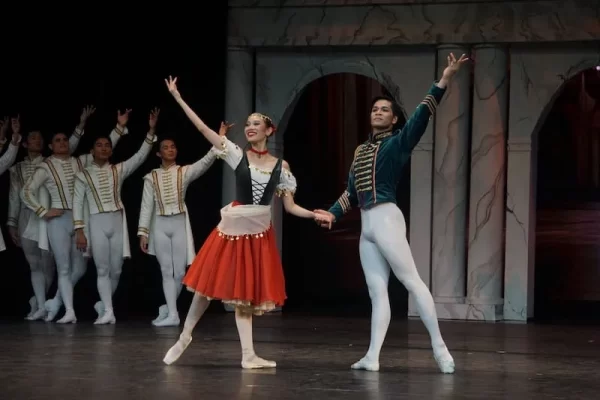
Abigail Oliveiro as the gypsy Paquita and Mark Sumaylo as Lucien; Photo Credit: Teddy Pelaez
It is no surprise that Paquita impresses the audience. The level of technical precision is not often seen in local productions. Still, there is room for greater stylistic depth. The younger dancers need to mature into the material rather than be carried by it. Character dances, in particular, need more bite and contrast to register fully.
The production would benefit from a stronger sense of Spanish flair and coquetry in the Grand Pas Classique, where style matters as much as technique. The Mazurka, a Polish dance, should stand out more clearly as a structural contrast within the ballet. It interrupts the classical flow with a shift in rhythm and weight, moving the action between narrative and display. In Ballet Manila’s staging, the ensemble moves with coordinated patterns, a lifted carriage, and stylized épaulement, but it calls for sharper accents, more grounded steps, and clearer attack in the footwork.
The Gypsy scenes also need greater roughness in tone and texture. Without that edge, the contrast between the aristocratic world and the character dances is softened, and the dramatic world loses some of its definition.
The production shows Lisa Macuja Elizalde’s growth from ballerina to creator of full theatrical works, while also revealing that the younger dancers are still catching up to her artistic vision.
This reviewer watched the 5:00 PM, June 20 show.
Tickets: P2,060 (Center) and P1,030 (Sides)
Show Dates: June 19 to 21
Venue: Aliw Theater
Running Time: approx. 2 hours and 15 minutes (with a 15-minute intermission)
Producer: Ballet Manila
Creatives: Lisa Macuja Elizalde (artistic director, choreographer, librettist); Marius Petipa, Joseph Mazilier, Pierre Malavergne (with excerpts from original choreography); Edouard Deldevez, Ludwig Minkus, Riccardo Drigo (music); Natalia Radulgina (ballet mistress), Alexander Kurkov (ballet master); Gerardo Francisco Jr. (rehearsal master and music master); Michael Miguel (costume and fashion designer); Julia Macuja (set designer); Carlo Reyes (lighting designer); Deidrich Tanteco (projections designer)
Featured Cast:
Paquita: Abigail Oliveiro, Shamira Drapete; Lucien: Mark Sumaylo, Jos David Andes; Iñigo: Romeo Peralta; Doña Seraphina: Stephanie Santiago; Spanish Governor Don Lopez De Mendoza: John Ralp Balagot; Paquita’s Friends: Jasmine Pia Dames, Shaira Comeros, Rafael Perez, Jessica Pearl Dames, Nanami Hasegawa, Vian Reign Pelegrin, Juan Angelo De Leon; Comte d’Hervilly: Rodney Catubay; Lucien’s Mother: Rissa May Camaclang; Young Lucien: Francis Andrei Umali

Comments