

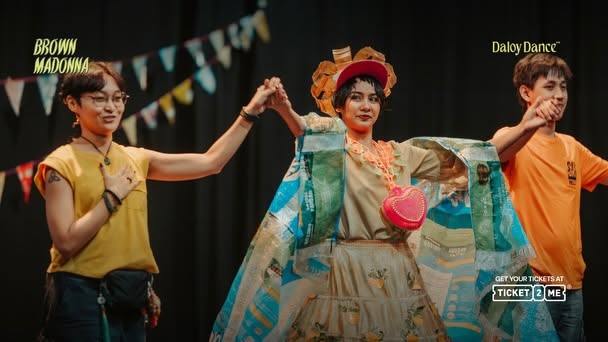
Inside ‘Brown Madonna’: Ea Torrado Weaving Family, Faith, and Labor
“Like Madonna, Torrado examines the power of reinvention, using fashion, performance, and imagery to explore identity, sexuality, and control.”
Dancer-choreographer Ea Marie Torrado and her 12-year-old Daloy Dance Company have challenged audiences with works that appear spontaneous or ritualistic but are built on physical ideas. Torrado’s rebellion lies in questioning what dance is expected to be, pushing away from traditional structures while searching for new ways of expression.
Her evolving work, a 70-minute Brown Madonna, developed with the guidance of adviser Eisa Jocson, who helped premiere the piece in Frankfurt last year, explores the contradictions surrounding the image of the Filipino woman. She likewise acknowledges prominent German dramaturg Alexandra Hennig and multidisciplinary artists Daniel Darwin and Perky Parong for their support.
The transformation begins with the costumes created by multimedia artist Leeroy New and associate designer Arvie Santos, whose background is in theater. Each layer carries cultural and social meanings. As Torrado removes the costume piece by piece, the clothing itself becomes part of the performance, shifting from a narrative worn on the body into an element of the stage.
First presented in 2018 as a dance theater piece influenced by pop icon Madonna, Brown Madonna has evolved into something more personal. Like Madonna, Torrado examines the power of reinvention, using fashion, performance, and imagery to explore identity, sexuality, and control.
At the center of the work are two opposing figures embodied by the same performer: the towering, plastic-covered matriarch/Mama Mary figure, and the exposed, illuminated body in a bikini and pointy bra reminiscent of Madonna’s iconic cone bustier by Jean Paul Gaultier. Through these contrasting forms, Brown Madonna examines the tension between the sacred and the sensual, the revered and the objectified, within the Filipino experience.
In Philippine culture, the sacred and the secular often exist side by side. New’s purposely kitschy costumes bring this tension to life, revealing the conflicting roles placed on Filipino women: as figures of devotion and care, yet also as objects shaped by commerce, desire, and expectation.
Bending Over Backward
At the beginning, Torrado stands on a platform like a fiesta queen waving to a crowd. She smiles as she walks toward the audience, immediately creating a connection with them. As she twirls, her skirt unravels into banderitas, transforming into swags in a fiesta. She plays with fans, tosses packets to the audience, and invites them into the performance.
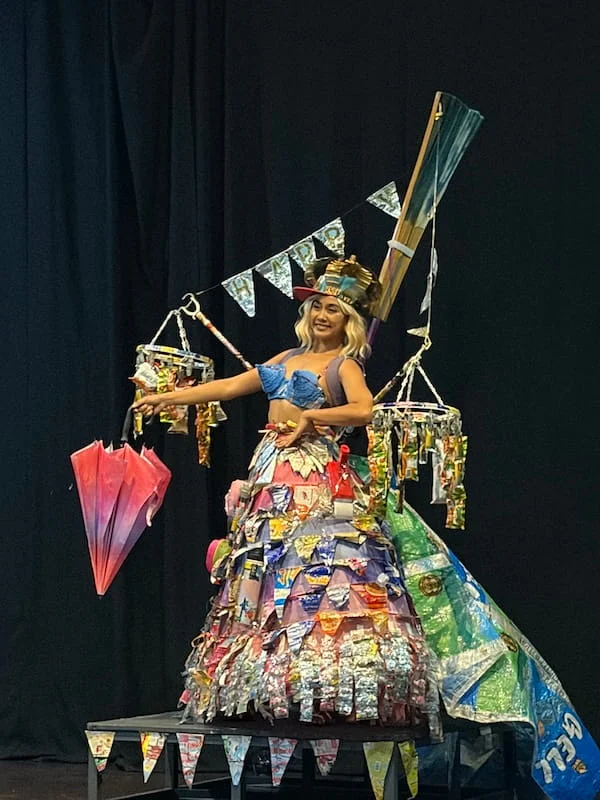
Leeroy New designed Ea Torrado’s first outfit with a fiesta aesthetic embodying souvenirs and sari-sari store snacks to evoke the sachet culture and kitsch; Photo Credit: Marge Enriquez
Then the mood shifts. Her body moves into spasms. With chutzpah, she tilts her pelvis towards the crowd, and a light emerges as a crowned doll appears, recalling the image of the Santo Niño.
She removes the skirt, revealing a bikini over flesh-toned leggings, and strapped high-heeled sandals. The costume flashes with neon lights as she begins twerking and shoulder shimmies, drawing laughter and applause from the audience. She sings pop songs before moving into a deep backbend, the tips of her bra cones pointing toward the ceiling, blinking with lights. Torrado later explains that the image refers to women who bend over backward to work and survive.
The performance shifts into a more personal space as she delivers a monologue reflecting on her life. She recalls conversations with her mother about her dark skin color. She crawls on all fours and disappears beneath a fabric made from rice sacks.
The artist later emerges to parody ballet, performing to the music of Bizet’s Carmen, a role she once danced during her time with Ballet Manila. Throughout the piece, moments of silence heighten anticipation. At one point, she removes a giant fan to reveal her breasts, evoking the burlesque dancers of an earlier era. The fan is then folded and carried on her back as she bends forward, resembling Christ carrying the cross.
Torrado then kneels and chants before walking toward the cape made of rice sacks with the Angel brand. She puts on the skirt again, transforming into a Blessed Virgin figure wearing the rice sacks as the veil and a plastic heart-shaped scapular. Carrying two bags, she chants as if offering blessings. The cheap bags become symbols of gifts she wants to share.
The karaoke influence returns as Torrado sings more pop songs and engages the audience through cheers and call-and-response. She shouts, “Ma-Mu Me,” turning the moment into a playful celebration.
The work ends with a rap about colonization. What began with the influence of a blonde pop icon transforms into a reflection on what women sacrifice under the conditions of a developing nation.
Autobiographical
Brown Madonna speaks about the struggles and contradictions faced by the Filipina. Torrado’s own story is woven into the work. Her mother, Cordelia Hattori, worked as an overseas Filipino worker in Japan to support the family. Torrado was raised by her late grandmother, Irene Ta-asan, whom she calls Nanay, who also worked as a helper. She connects those experiences to her role as founder and artistic director of Daloy. Like her mother and Nanay, she carries responsibilities beyond herself, supporting dancers and scholars while taking on multiple gigs to sustain the company.
Growing up in Bagong Bantay, Quezon City, Torrado took ballet lessons at Ballet Manila from childhood, seeing dance as a possible path toward a better future. But she often felt different from her classmates, many of whom arrived in cars accompanied by nannies. During the rainy season, her grandfather carried her across flooded streets so she could attend class.
“I’m 40 now but I’m still poor,” Torrado jokes. But poverty is not measured only by money. Through dance, she has gained a wealth of experiences from international performances, sponsored travels, and grants.
Her first costume in Brown Madonna, inspired by Filipino culture, reflects this history.
The Maria Clara-inspired skirt is made from colorful plastic wrappers, sachets, and foil packaging. The festive appearance is paired with a blue conical bra, transforming Torrado into an allegorical figure: a Filipina carrying the weight of work, stories, and memories from daily life.
In contemporary Philippine performance art, these costumes become a sharp commentary on the Filipino “sachet economy.” The design incorporates dangling sachets and familiar packaging that recall the merchandise displayed outside sari-sari stores. The triangular buntings around her skirt reference banderitas, commonly seen during town fiestas.
The headdress resembles a festival crown made from recycled plastic bottles, a signature material of Leeroy New, painted gold. It gives Torrado the appearance of both a playful fiesta queen in a blonde wig and a Mama Mary figure.
Two giant fans sourced from Quiapo become one of the most symbolic elements of the costume. When unfolded behind Torrado, they create the image of a halo. Embedded in the fans are circular photographs of family portraits, transforming the object into a reflection of Filipino identity and memory.
Another striking feature is the bamboo-like carrying pole across her shoulders, with two suspended baskets hanging on either side. It evokes the maglalako, the roaming street vendor who carries goods from one neighborhood to another, representing the resourcefulness and persistence of ordinary Filipinos. The pink umbrella recalls the everyday reality of Filipino street vendors and commuters, where umbrellas are essential protection from both sun and rain.
Together, these elements transform the costume into a visual narrative of Filipino life, culture, and kitsch. The carrying pole suggests livelihood, while the baskets become vessels of survival. During the performance, Torrado tosses sachets to the audience as gifts, turning objects associated with consumption and waste into symbols of generosity.
Glowing and Rapping
The second costume of a high-cut bikini bottom and high heels recalls the look of performers in a girlie bar. The shoes are wrapped in the same multicolored branded foils, physically connecting the performer to the consumer landscape being examined.
But the costume also challenges that image of glamour. Torrado’s body becomes a canvas that explores the tension between the country’s love for spectacle and the realities of labor and survival. The exaggerated styling transforms familiar images of entertainment into a commentary on how the Filipina body is displayed, admired, and consumed.
With neon lights embedded at the bra’s tips, the costume shifts into an electric spectacle. Battery-operated lights create intense white and neon-green glows from her chest and pelvic area, turning areas associated with reproduction and sexuality into visual focal points. Her movements shift from provocative cabaret poses, with hands placed above her head, to moments of collapse on the floor.
The effect is both surreal and unsettling. The dancer becomes a glowing figure shaped by a culture of survival, where women often take on difficult and undervalued work. The costume becomes a provocative exploration of how the Filipina body is commodified, viewed, and expected to perform.
Torrado then returns to the Mama Mary image, constructing a massive bell-shaped silhouette that recalls traditional colonial religious icons. The high, draped veil made from rice sacks covers her head and cascades down the sides, evoking the forms of the Virgen de la Soledad.
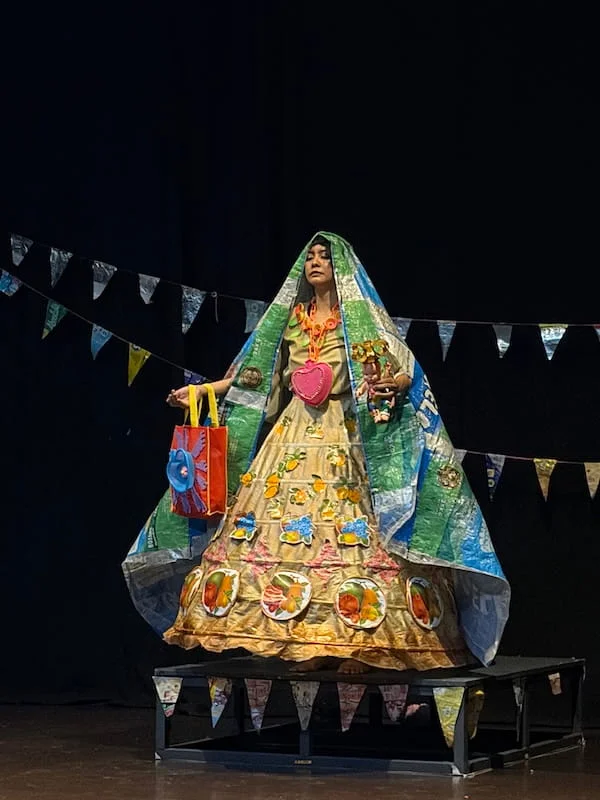
Mama Mary image with a veil made of rice sacks emblazoned with the Angel brand and a glowing heart necklace assembled from plastic, little bowls, strainers, spoons, and toy baskets; Photo Credit: Marge Enriquez
The entire garment is made from industrial woven plastic sacks, specifically large commercial rice sacks (sako ng bigas) in green, blue, and white, complete with visible branding and commercial text. The expansive skirt is decorated with rows of colorful circular cutouts resembling fiesta paper plates, featuring kitschy illustrations of local fruits, vegetables, and fish. A bright pink heart hangs around her neck like an oversized scapular.
On one hand, she carries a red reusable shopping tote with a cheap plastic plate attached. On the other, she holds a small crowned Santo Niño doll, mirroring the posture of a maternal caretaker or religious devotee. Her body remains rigid, her gaze lifted and solemn, detached from the audience.
“I like the idea that she’s in a Mama Mary costume and then she raps,” Torrado says. “You can be motherly, you can be loving, but also you can be ghetto, you can be raunchy, you can be angry. At the same time, I wanted the image not just to be still, but someone with a voice. Someone who can question, who can open up conversations.”
Ultimately, Torrado draws a line between inheritance and departure. She relates deeply to her grandmother and mother, yet works within a different artistic and economic landscape. What she describes as a “classic resilient Messianic-Savior story” becomes both burden and impulse. “I feel like I’ve inherited that,” she says. “I feel like I have to do everything. I have to work so hard. I have to save everyone under my care.”
Even the turn toward singing began as a kind of provocation. “It was a joke,” she says. Constant fundraising for Daloy, which she considers her artistic child, pushed her to try new forms. “Let’s just do a musical,” she recalls in jest. “We haven’t tried everything yet, like singing and theater.”
In the end, the shift also reflects a practical reality. In the Philippines, musicals tend to receive more support and wider audiences than contemporary dance. What began as a joke becomes a strategy for survival, and a reminder that for Torrado, creation is always tied to care, labor, and the question of how art can be sustained.
Brown Madonna will be shown on August 15 and 16, 2026, at the Myra Beltran Dance Forum in Quezon City.

Comments