

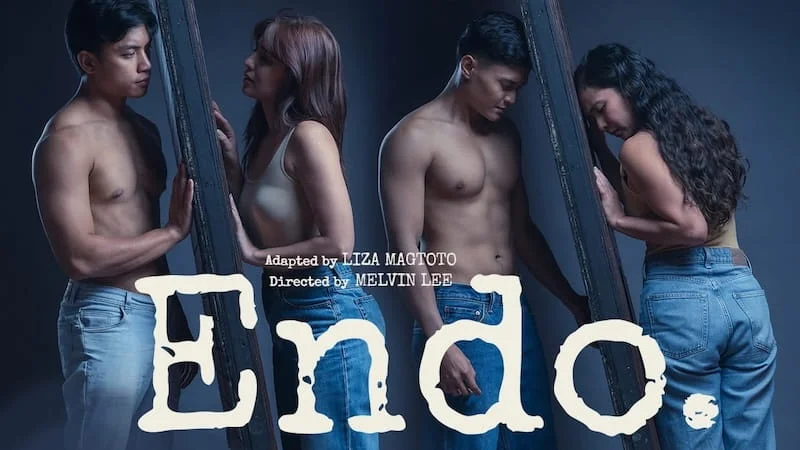
‘ENDO’ Reimagines a Labor Story for Today’s Economy
Read about how ENDO’s creative team and cast turn a story of contractual labor into a timely portrait of work, instability, and love.
More than a decade since the 2007 Cinemalaya film finalist ENDO by Jade Castro, the story continues to hold its ground in today’s realities, where job insecurity persists, only in more complex and evolving forms. For stage adaptation director Melvin Lee, the material extends beyond its original context. “It’s not just a story of ordinary people, but you will look into the dimension of the lives of people living in a situation in a gig economy,” he said.
Present-day Endo
The concept of “end-of-contract,” or endo, remains deeply embedded in the workforce, but this stage production widens its scope to include other forms of precarious labor today, from freelancing and gig work to hustle culture, side jobs or raket, and probationary employment.
Playwright Liza Magtoto pointed out how the term itself has shifted over time. “‘Yung definition kasi ng endo noon, five months eh. Ngayon mayro’n nang subtle ways of going around it.” She cited the growing reliance on recruitment agencies, which now mediate hiring for many companies. Still, as she emphasized, “the insecurity is still there,” especially when placement is neither immediate nor guaranteed. Magtoto also raised the increasing presence of artificial intelligence in the workforce. “So, it’s actually the BPO workers, who are inputting stuff, that will [be replaced by them]…Some years from now, they might not be there anymore. So, there’s a redefining of endo.”
Assistant director and dramaturg Eric Dela Cruz described this shift in terms of what he called a “horizontal algorithm.” Previously, contractual and probationary workers were primarily anxious about reaching the six-month mark. “The response to their instability is to freeze and make their dreams small to fit within the six months,” he said. “But now, it’s different. It still exists. But because the world is so fragmented, there are so many gigs…The question now is, who defines it? The hierarchy [today] is more horizontal because your validation, your importance, is defined by the algorithm. That’s why you always hear [about] the rating.” In this system, shaped by feedback loops and platform-based work such as ride-hailing and delivery services, workers, said Dela Cruz, begin to ask new questions: “Will I be relevant tomorrow? Will I have enough rating to sustain me tomorrow?”
Lee also shared that Darwin Mariano, founder of Ticket2Me, was the first to suggest adapting the indie film for the stage, eventually partnering with PETA Plus to bring the production to life. Julie Anne Bautista, Ticket2Me’s CEO, described ENDO as a “well-written, good story, very deep, well-made. Simple but impactful.” At its core, the story addressed urgent concerns at the time of its release, yet continues to resonate, reflecting how little—and how much—has changed.
Living on the Line
In translating the film to the stage, the team encountered a different set of challenges. For Lee, one of the biggest shifts was handling the film’s constant changes in location—something easily done on screen through editing, but far more demanding in live performance. He shared that they leaned into the strengths of theater to address this, maximizing “the capacity of the actors and the hybridity of mixing realism and the physicality of theater.” What emerged was a staging that mirrors the pace of the world it depicts. “Shift after shift; fast-paced,” Lee said, describing the “temperament of the gig economy.”
For Royce Cabrera, who plays Leo, the material hits close to home. “Personally, I consider myself part of the economy,” he said, noting that even with a contract under a media agency, he still takes on side jobs to sustain himself. Cabrera put it candidly: “May mga bagay na gagawin mo para sa kaluluwa, may mga bagay na gagawin mo para sa bulsa.”
View this post on Instagram
Meanwhile, Jasmine Curtis-Smith, who plays Tanya, pointed out that acting is inherently contractual. “Pagdating dito sa industriya ng Arts, maraming gano’n ang pinagdadaanan kasi hindi naman lahat pantay-pantay ang [talent fee].” She explained that for actors, insecurity often lies in the uncertainty of securing the next project. At the same time, she acknowledged a certain degree of privilege in being able to choose to stay in the arts, unlike others who have no choice. Curtis-Smith, known for her work in television and film, shared that this marks her return to theater following her role in 3 Upuan. “Kung may opportunity ka to also exercise a different muscle of acting—live performance with a live audience—I think it’s always great to do that.”
Rissey Reyes-Robinson, who alternates for Tanya, became open about the financial realities of theater. Part of sustaining a career as a performer, she said, is learning how to expand and market one’s skills. “Lahat ng pwedeng malagay mo sa skillset mo as an entertainer, hosting, tapos teaching for a lot of these people, directing, or choreographing…Lahat ng skillset na pwede mo i-learn at i-apply, gagamitin mo talaga para kumita ng pera.”
View this post on Instagram
It is within this context that Lee framed the production not only as a critique of labor conditions, but also as a celebration of workers themselves. “Itong play na ito ay hindi gagamit ng projection or other technology bukod sa light and sound dahil part of paying homage to the workforce is also to showcase the strength of what the body can do.”
Love Under Pressure
The team explained that what makes ENDO resonate is how it brings together intimacy and economic struggle, showing how people try to sustain relationships while navigating unstable work and modest means. As Dela Cruz put it, “In intimacy, the opportunity to live a life or build a life is always interrupted by a text message or a [booking notification].”
In a romance shaped by financial strain, differences in priorities begin to surface. Lee explained, “If you focus dun sa mga goals ni Tanya at ni Leo, magkaibang magkaiba sila…Dictated yun ng kanilang economic situation. As much as they want and they love each other, hindi yun masustain.” The staging leans into this tension, grounding larger systemic issues in something deeply personal, suggesting that the conditions of society inevitably shape individual relationships.
For Esteban Mara, who alternates for Leo, taking on the role underscored the importance of truly knowing the person one chooses to love. He noted how compatibility in values often becomes the point of conflict. “It [really] depends on how you’re going to deal with it, your ‘contract’ with each other.”
Meanwhile, Kate Alejandrino, who plays Candy, Leo’s past lover, pointed to a quieter moment in the play that she hopes audiences pay attention to. “Favorite ko actually sa play, yung eksena ni Leo at ni Tanya nung pagod na pagod si Leo tapos sinalubong siya ni Tanya. Kasi ‘yun talaga yung feeling natin at the end of the day pag nagawa mo na lahat,” she said, describing that familiar longing for rest and comfort, and the presence of someone who meets you in the middle of it.
View this post on Instagram
Overall, the production promises to leave audiences with a deliberately mixed aftertaste. “Malalasahan nila yung pait pero sana lumabas sila na merong anghang,” Magtoto said, expressing her hope that viewers—whether workers, corporate officials, or those in government—become more humane in how they see and respond to these realities.
The stage adaptation of ENDO, produced by PETA Plus in partnership with Ticket2Me, will run from April 10 to May 10 at PETA Theater Center in Quezon City.

Comments