

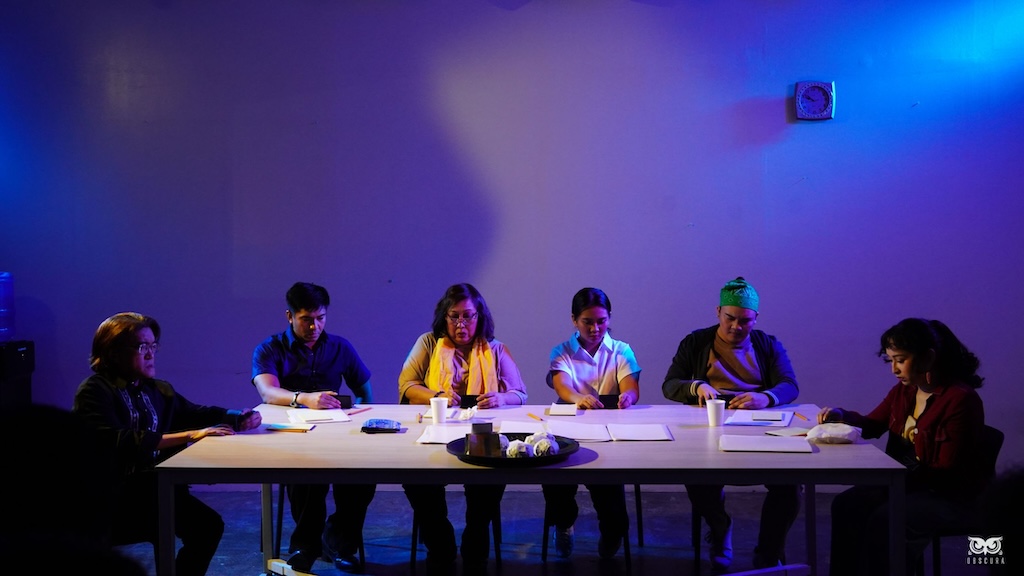
REVIEW: ‘People V. Dela Cruz’ is headed for a mistrial
There’s a persistent suspicion that surfaces whenever the idea of a jury system is raised in the Philippines: that ordinary citizens, left to their own devices, would be incapable of deliberating responsibly when someone’s life or freedom is at stake. People V. Dela Cruz, a one-act satire by The Corner Studio, takes that suspicion as a given. Set inside an imagined jury room—stark, nondescript, dominated by a long central table arranged so the jurors face the audience—the play locks six Filipinos together and deliberation unravels immediately.
Written and directed by Eldrin Veloso, the piece presents itself as a timely interrogation of judgment in the age of social media. What it ultimately offers, however, is a hollow conflict of underexamined archetypes that lasts for about an hour until it ends abruptly and the audience is sent on their way, offered complimentary slices of chicken sandwiches.
The charge under deliberation involves a police officer killed after a suspect allegedly fired the officer’s own gun—a scenario already loaded with systemic violence, class prejudice, and institutional abuse, especially given the context of tokhang-era practices like planting weapons to justify claims of nanlaban.
Type against type
People V. Dela Cruz does not so much ask whether we are prepared for such a civic responsibility as assume we are not. For Veloso, a jury room of an accused man’s peers is one where volume replaces thought. Deliberation, in this room, is defined by escalation: arguments pile up, personalities harden, and positions calcify. The play treats this descent into noise as inevitable, as though collective decision-making can only ever degrade into stalemates as people take things personally and make the case about themselves.
Veloso populates his jury with familiar sketches of the sort of keyboard warriors you might encounter on comment threads—combative, openly biased, easily influenced, proudly unreflective—and then makes the impossibility of consensus the central conflict.
The characters feel less like the product of civic selection than of reality television casting. Each one is engineered to clash. Each one arrives already locked into their worldview. Crucially, any credible jury selection process would have excused all six of them from serving. Every juror onstage demonstrates, almost immediately, why they are unfit to weigh such a case: entrenched political bias, religious absolutism, personal agendas, and an inability to separate opinion from evidence.
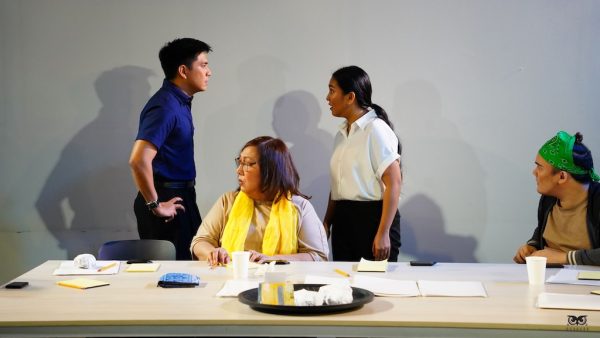
L-R: JP Basco, Emlyn Olfindo-Santos, Althea Aruta, Aaron Dioquino; Photo Credit: Krizhal Daryl Ordas
Rather than grappling with that contradiction, the play ignores it. Jury selection, sequestration, and insulation from external influence—basic safeguards of the system being dramatized—simply do not apply here. The jurors enter already saturated by online discourse, reacting to speculation and judgment about the case and about themselves. The rules bend whenever the play needs them to, making the premise increasingly difficult to take seriously.
One’s own peers
Given the narrowness of the writing, most of the cast is tasked with sustaining a single behavioral note. Some performances are competent and committed, but the material rarely allows them to complicate their characters beyond their initial function.
JP Basco’s Orion embodies the self-styled rationalist, quick to police others for emotional reasoning while remaining oblivious to his own investments. Aaron Dioquino’s Lean is permanently confrontational, his political aggression shaded with a hint of opportunism. Pauline Arejola’s Solara is consumed by anxiety over perception and scrutiny, her sense of self tightly bound to how she is being perceived as part of this group. Althea Aruta’s Katniss is unfailingly compassionate and morally upright, while Emlyn Olfindo Santos’s Marian leans into a familiar religious caricature for humor. These performances land where they need to, but they are constrained by characters that never evolve.
Mark Aranal’s Mayor Rico, however, cuts deeper. He plays the character as a familiar breed of local politician: confident when unchallenged, evasive when pressed, but ultimately cowardly. Still, in a play dominated by types, Aranal manages to suggest a person.
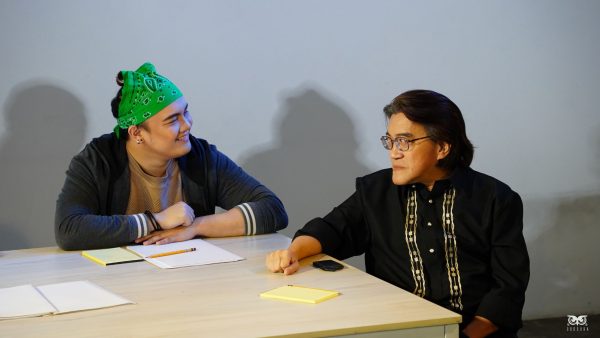
L-R: Aaron Dioquino, Mark Aranal; Photo Credit: Krizhal Daryl Ordas
Staging dysfunction
The difficulty with People V. Dela Cruz is not that it takes a stance, but that it confuses assertion with examination. The play treats the failure of deliberation as self-evident, as though placing six opinionated Filipinos in a room can only ever produce dysfunction. There is no curiosity about what responsibility might demand of these characters, or how the weight of deciding another person’s fate could force change.
In the end, Veloso isn’t really examining whether a jury system could work here. He’s staging a room full of people he clearly doesn’t think could jury a case like this and letting them confirm his suspicion. That approach may provoke recognition or uneasy laughter, but it does little to deepen the conversation it invokes.
People V. Dela Cruz wants to feel provocative. What it mostly feels is underexamined–content to gesture at complexity rather than engage with it. The result is a show that asks a big question—and then settles for a very small answer.
This reviewer watched the 7PM, January 16 show.
Tickets: Php 800.00
Show Dates: January 16-24, 2026
Venue: The Corner Studio, J&T Building, Magsaysay Blvd, Santa Mesa, Manila
Running Time: approx. 1 hour (no intermission)
Company: The Corner Studio
Creatives: Eldrin Veloso (writer and director), Pat Gregoro (stage manager)
Cast: Emlyn Olfindo-Santos, Althea Aruta, JP Basco, Pauline Arejola, Rain De Jesus, Aaron Dioquino, Mark Aranal

Comments