

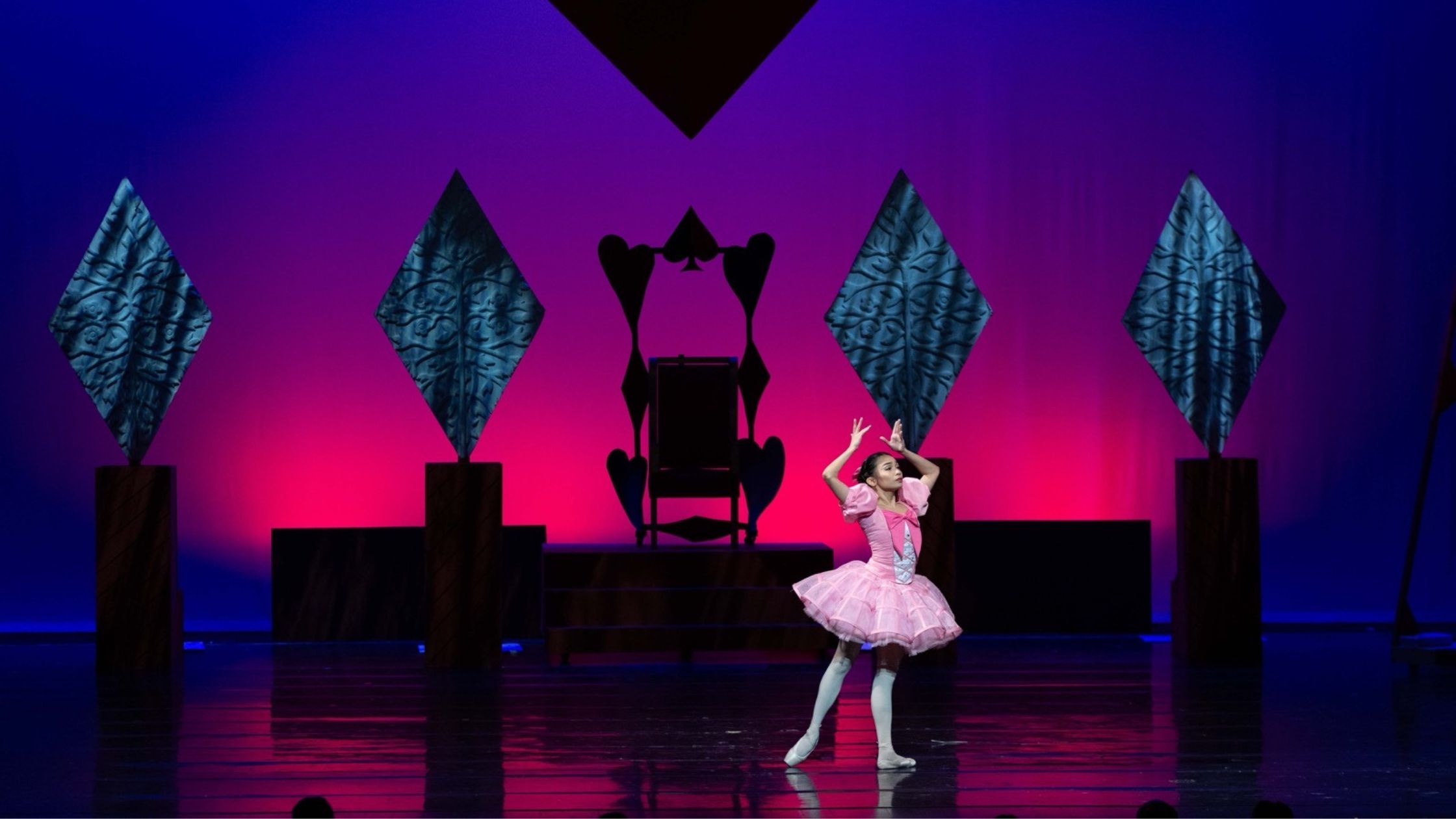
REVIEW: Ballet Philippines Elevates Its Technique but Loosens Its Grip on Alice’s Story in ‘Alice in Wonderland’
At its finest, Ballet Philippines’ (BP) Alice in Wonderland revealed a company sharpened under artistic director Mikhail Martynyuk. The technique was impressively clean. Not a single wobble interrupted the balances or pirouettes, which were delivered with a consistency that spoke of meticulous studio discipline. The dancers carried themselves with lifted torsos and generous lines that read beautifully across the stage.
Rudolph Capongcol’s Prince and Gia Gequinto’s Cat, strong dancers to begin with, pushed themselves to a higher level. Their line, projection, and steadiness had a new fullness that gave their roles greater weight. Even in the souvenir program photo of Ian Ocampo, the alternate Prince who was indisposed for this production, there was a noticeable refinement in his carriage and a further lengthening in his line.
Regina Magbitang as Alice continues to grow in command and clarity. Rebounding from her injury, Nicole Barroso reminded audiences that her artistry extends well beyond solid technique. As the Red Queen, she attacked the choreography with an imperious energy, shaping each gesture with intention and giving the character a vivid presence.
Eduardson Evangelio was sprightly as the White Rabbit, moving with natural elevation and a suave, effortless grace that kept the character lively.
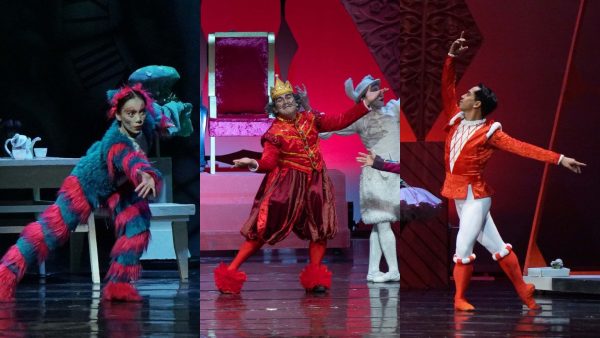
L-R: Gia Gequinto (Cat), photo by Cecile Carlos-Janicek; Emmanuel Guillermo (King), photo by Larry Salgado; Rudolph Capongcol (Prince), photo by Cecile Carlos-Janicek
The surprise highlights, however, came from Emmanuelle Guillermo, who brought a deft comic instinct to the role of the King. Gequinto also proved compelling in her stagecraft; her instincts as a choreographer allow her to animate the stage even in moments when she was not the focal point. The ensemble delivered some of the production’s most seamless moments, moving as a single unit with lines that stayed clear and beautifully aligned even in the busier passages.
Despite having no budget for an original score, Martynyuk stitched together a selection of Claude Debussy’s works in a way that supported the shifting moods of his choreography.
CHILD’S CRITIQUE
But take it from the mouth of babes. Karlo, eight years old, arrived at Solaire Theater buzzing with excitement for BP’s Alice in Wonderland. It is about a curious girl who slips into a world where nothing follows the rules, and every encounter with the quirky characters feels like a strange mix of whimsy, confusion, and delight. He had devoured Lewis Carroll’s book many times, so he thought he knew exactly what to expect. Instead, the ballet made him thoroughly puzzled. There was never a love story in the book, he insisted, so how did a Prince in red suddenly become Alice’s consort? And since when did the Red Queen have a King or take part in a flirtatious triangle with the Prince? In Carroll’s world, she had neither. Asked if he understood the story, Karlo gave a polite yes and explained that he recognized many of the characters. However, anyone who barely remembers the book or never read it at all might find the plot hard to follow.
His grandfather later tried to make sense of it for him, noting that choreographers take artistic liberties, and that ballet companies need to create meaningful roles for their male dancers—in this case the Prince and the King—which inevitably reshapes a classic tale.
We could relate to Karlo’s confusion. The moment the Prince appeared, he and Alice launched into a pas de deux with no narrative setup to justify why they were dancing together. It felt abrupt, as if the two had matched on a dating app and immediately recognized each other onstage. Without a visual or dramatic cue explaining his presence, the pairing seemed to materialize out of thin air. The first pas de deux offered no hint of developing affection or curiosity between Alice and the Prince. Instead, it unfolded as a display of classical partnering, complete with familiar poses and lifts taken from well-known pas de deux vocabulary. Since the choreography provided no emotional anchor for the couple, the dancers defaulted to a generic classical polish, focusing on line and deportment rather than character or connection.
This is not the first time the same issue has surfaced in the company’s storytelling. The production still struggles to answer the basic questions of narrative logic. What is motivating these steps? Why are these characters moving this way? Without those answers, the action can feel like a sequence of steps rather than a story. For enjoyment’s sake, we longed for clearer character development. Peter San Juan, often so vibrant in other ballets, was reduced to simple, almost rudimentary movement as the Mad Hatter.
MISSING IN ACTION
At times the action also sagged. The musical selections, all drawn from Debussy, tended to blur together, creating a sense of repetition. Except for the House of Cards scene, the set design was busy and never gave the eye a clear place to rest. The stage was unusually dim for a family-oriented production, and the constant tracking spotlight that followed dancers around the stage grew tiring to watch.
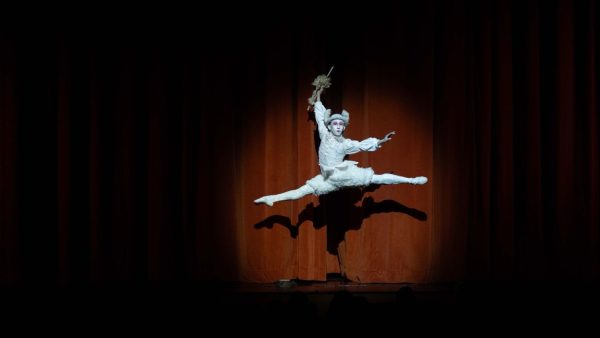
Eduardson Evangelio as the White Rabbit; Photo Credit: Larry Salgado
The attention to movement and lighting without a clear creative intention is not unique to BP. You see it in many companies now, even in contemporary groups, where choreography becomes a tidy arrangement of steps rather than something that carries meaning. The movements look interesting, but they do not always say anything. Where is the objective? Why begin with Alice in a library instead of the field where she falls into the rabbit hole and discovers the doors? Why was there a triangle between the Red Queen, the King and the Prince but was briefly developed? Choreography needs a blend of emotion, logic, tradition and originality. It shapes not only the performance but also the personalities onstage, and that is what I still find missing in much of the BP repertoire.
The dancers, to their credit, have noticeably sharpened their technique, which is attributed to Martynyuk’s firm and methodical approach. He has shown that he is an effective ballet master, but it will take time before he gains a real grasp of choreography. At this point, these dancers need substantial material that can draw out the best in them. Whenever I watch BP, I can’t help thinking how much more they could reveal if they worked with a wider range of choreographers and directors who know how to wring out their artistry. I have noticed this in other companies as well. They get too comfortable repeating the same formula, relying on one choreographer for an entire season. The result is a kind of sameness that leaves the work feeling predictable. This aesthetic monotony flattens the dancers’ potential and leaves the audience wishing for more variety and risk.
Tickets: P4,017 (orchestra center), P3,347.50 (lower orchestra side), P2,410.20 (upper orchestra side), P2,008.50 (premium gold center and side), P1,071.20 (lower balcony center and side), P803.40 (upper balcony center and side)
Show Dates: December 5, 8 PM; December 6-7, 2 PM and 7 PM
Venue: The Theatre at Solaire
Running Time: approximately 1 hour and 45 minutes (with a 15-minute intermission)
Creatives:
Cast: Jemima Reyes-Ocampo, Danielle Kleiner, Nicole Barroso, Ma. Regina Magbitang (Alice); Ma. Regina Magbitang, Jemima Reyes-Ocampo, Nicole Barroso, Danielle Kleiner (Red Queen); Rudolph Capongcol, Ian Ocampo (Prince); Eduardson Evangelio, Mark Anthony Balucay, Carlo Padoga (White Rabbit); Rudolph Capongcol (Caterpillar); Peter San Juan, (Mad Hatter); Carlo Padoga, Carl Lacaba, Earvin Guillermo (Mad Rabbit); Emmerson Evangelio and Alexis Piel, Eduardson Evangelio and Carlo Padoga (Twins); Joanne Sartorio-Guillermo, Gia Gequinto (Mouse); Gia Gequinto, Clarise Miranda (Cat); Emmanuel Guillermo (King); Krystn Janicek (Duchess); Danielle Kleiner and Nicole Barroso, Jemima Reyes-Ocampo and Nicole Barroso, Danielle Kleiner and Ma. Regina Magbitang (Lead Flowers)
Company: Ballet Philippines

Comments